
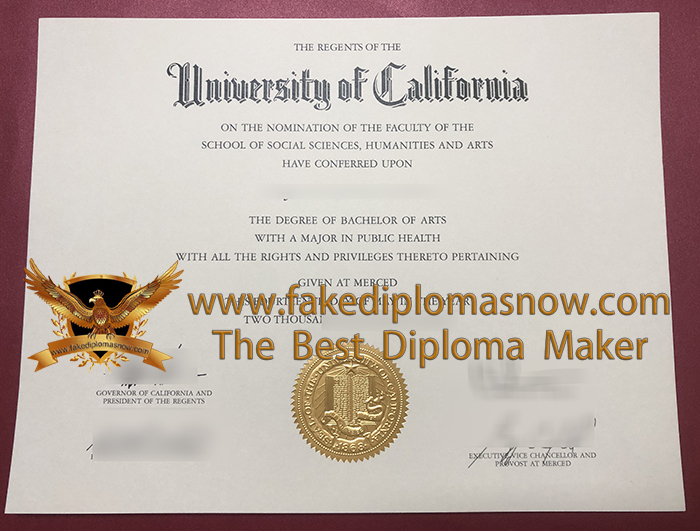
UC Merced degree certificate sample
Founded in 2005, the University of California, Merced (UC Merced) is the tenth and newest campus in the University of California system. UC Merced degree certificate sample. As the first research university established in the 21st century in the United States, it rose to the Carnegie Medal of Research (R1) level within just two decades, ranking 38th among public universities in the 2022 US News & World Report rankings. Located in California’s San Joaquin Valley, adjacent to Yosemite National Park, its unique geographical intersection fosters its interdisciplinary educational philosophy.
Comprehensive Degree Programs and Academic Scope
UC Merced comprises three colleges: the College of Engineering, the College of Natural Sciences, and the College of Social Sciences and Humanities. It offers over 60 undergraduate majors and 18 master’s and doctoral programs. Undergraduate degrees include Bachelor of Arts (B.A.) and Bachelor of Science (B.S.), while graduate degrees include Master of Science (M.S.) and Ph.D. All programs are offered on a semester basis. The university currently has approximately 8,151 undergraduate students and nearly 400 graduate and doctoral students, with a student-to-faculty ratio of 19:1, and 60% of undergraduate classes have fewer than 30 students.
Flagship Undergraduate Program: MIST – An Interdisciplinary Program of Innovation, Sustainability, and Technology
The Bachelor of Arts in Management, Innovation, Sustainability, and Technology (MIST) is UC Merced’s most distinctive interdisciplinary undergraduate program, taught by the Department of Complex Systems Management (MCS). This program requires only 15 courses and 52 credit hours, building a “T-shaped” skills matrix: vertically strengthening core management skills such as leadership, organizational behavior, entrepreneurial finance, and policy analysis; horizontally integrating three modules: systems thinking, data science, and environmental management. A key feature of the curriculum is its transformation of real-world governance issues in California’s Central Valley—climate justice, wildfire management, national park protection, and energy policy—into case studies and team projects, cultivating students’ decision-making abilities that consider the triple bottom line of “people, planet, and profit” (PPP). Students can choose from three pathways: innovation management, sustainable management, and technology management. Graduates find employment in high-growth fields such as new energy consulting, environmental health and safety, financial analysis, and project management. Engineering Frontiers: Semiconductor Materials and Computational Biology
The School of Engineering closely aligns with industry needs. The Bachelor of Science in Materials Science and Engineering (Semiconductor Track) addresses the talent gap in the US chip strategy, requiring courses in semiconductor device physics, process control, characterization methods, and electron microscopy. Students can participate in cutting-edge electives such as 3D printing, nanotechnology, and computational materials. The Bachelor of Science in Applied Mathematical Sciences (Computational Biology Track), offered by the School of Natural Sciences, deeply integrates mathematical modeling, algorithm design, and molecular biology experiments, paving the way for students to enter bioinformatics and quantitative medicine research.
Graduate Education: Complex Systems Management and Interdisciplinary Research
The graduate program offers 12 Master’s programs and 13 Doctoral programs, all taught in person on campus; there are no distance learning degrees. The Master of Science in Complex Systems Management (MCS) is representative of the graduate program: it requires 24 graduate credits, with core courses including MIST 252 (fundamental theory) and two methodology courses, MIST 251 seminars, and passing a comprehensive examination or defending an original thesis. Elective courses cover spatial analysis, data science, network science, service innovation, and political ecology, offering two focused areas: decision science and analysis, and project management. The application deadline is January 15, 2026.
The Underlying Logic of Undergraduate Education: The “Bachelor’s Degree Markers” System
UC Merced uniquely proposes five hallmarks of a bachelor’s degree: academic depth and breadth, cultural awareness and sensitivity, community engagement and civic responsibility, self-awareness and introspection, and interpersonal collaboration and leadership. General education courses are designed around five learning outcomes: “Inquiry into Research University Life—Critical Reasoning—Cross-Media Communication—Cultural and Global Awareness—Contribution to the Public Good.” Honors programs require students to complete original research or creative works and to implement social change within diverse communities.
Tuition and Admission Reference
For the 2025-2026 academic year, the average annual tuition for in-state graduate students is $11,220, and for out-of-state students, it is $26,322. The total cost of tuition and living expenses for in-state undergraduate students is approximately $62,193. With its exceptionally high social mobility ranking (4th in the US in 2022), its partnership with Lawrence Livermore National Laboratory, and its student-centered, small-scale research university positioning, UC Merced offers an irreplaceable growth option within the University of California system for students seeking high levels of student-faculty interaction and interdisciplinary solutions to real-world problems.