
Hochschule Fresenius Urkunde
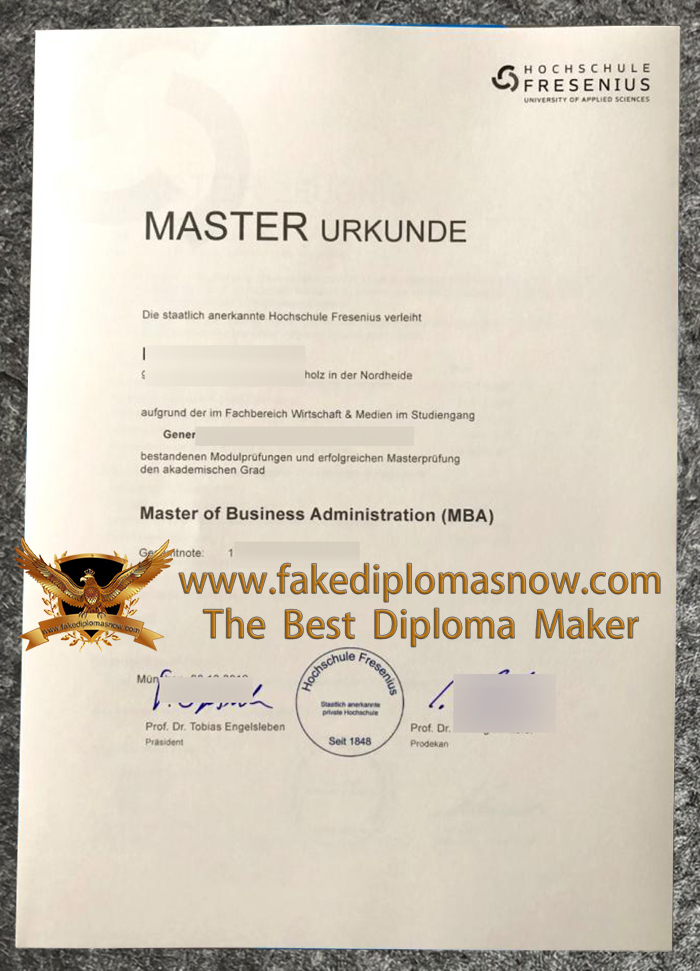
Hochschule Fresenius Urkunde from Germany. The Flensburg University of Applied Sciences (Hochschule Fresenius), also known as the Flensburg University of Applied Sciences, is a renowned public university of applied sciences in Schleswig-Holstein, Germany. Located in Flensburg, the northernmost city in Germany, its origins trace back to a chemical laboratory established by the Fresenius family in 1848. It officially became a state-recognized private higher vocational college in 1974, and has since developed into a well-established and forward-thinking applied university. It is also a shareholder university of BSIC. IU Internationale Hochschule urkunde.
The university has three faculties: Chemistry and Biology, Health Education, and Economics and Multimedia. It offers 13 full-time and 4 part-time in-service training courses, as well as 4 continuing education courses. Its core strengths lie in wind energy engineering, biotechnology-process technology, and computer-aided mechanical engineering. The wind energy engineering program was the first of its kind established in Germany, focusing on addressing the talent shortage in the new energy field. Its internationally renowned data communication program also enjoys a high reputation.
As a prime example of German Universities of Applied Sciences (FH), the school upholds a practice-oriented educational philosophy, closely collaborating with industry and providing students with abundant internship and project opportunities. Graduates are particularly sought after by European companies in the field of new energy. Simultaneously, the school boasts a broad international cooperation network, establishing partnerships with numerous institutions worldwide and offering convenient pathways for international students to further their studies, helping them broaden their global perspectives.
The school currently has approximately 3,000 students, with a balanced student-to-faculty ratio. Classes emphasize interactive teaching combined with practical application, and the school is equipped with comprehensive teaching facilities and research platforms, balancing academic instruction with practical research. Its flexible curriculum, distinctive professional characteristics, and pragmatic talent cultivation model make it an important base for cultivating applied talents in Northern Germany, and a high-quality institution focusing on new energy and applied disciplines, aligning with industry needs.