
Degree Verification
Wondering how employers really verify degrees—what gets checked, which myths to ignore, and how to prepare ethically? Keep this in mind: verifications come from official registrars, not photos or digital images. Our replica documents are for display purposes only.
The 60-second reality of degree checks
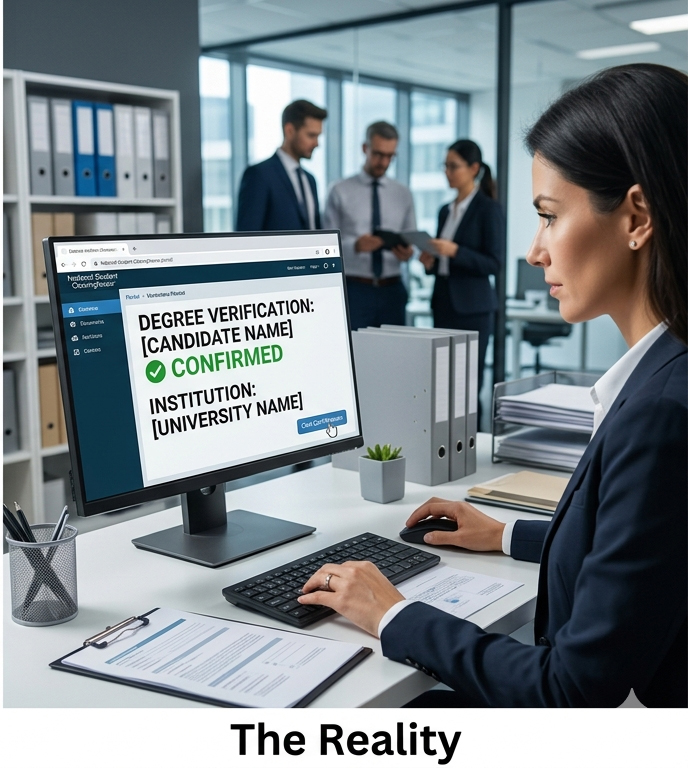
Since official confirmation comes from registrars, not pictures, imagine this: your background screener logs into the National Student Clearinghouse (NSC)—the main U.S. degree-verification database—enters your name, school, and expected graduation date, then clicks “verify.” In under 60 seconds, the system returns your institution, degree level, major, and official conferral date.
Large employers and regulated fields like healthcare and finance use this system daily. If your resume says “B.S. in Comp Sci, May 2022” but the registrar lists “B.S. in Computer Science, June 10, 2022,” the system will flag the discrepancy.
Most Fortune 500 Companies, hospitals, banks, and schools require you to sign a FERPA (Family Educational Rights and Privacy Act) consent form, after which third-party screeners run the official check. Even small mismatches can quickly delay job offers—being accurate from the start saves valuable time.
✅ Short answer
Yes, many employers do verify degrees, especially when a degree is a hard requirement, for regulated or senior roles, or if your resume shows inconsistencies. Expect an official check through the registrar or NSC once you sign consent.
Why degree verification matters right now
Degree verification has become standard practice for several key reasons: remote hiring has grown rapidly, compliance audits have tightened, and regulated industries simply cannot afford errors. This includes healthcare, education, finance, and the public sector—where compliance teams verify degrees just as rigorously as professional licenses.
Meanwhile, clearinghouses and digital registrar systems have made verification simple and affordable, so employers have added it to their standard background check packages. The result: more checks, conducted earlier in the hiring process.
Most large employers run degree verifications through the NSC or a third-party screening service that connects directly to registrar portals. Verification is fast when your records match perfectly—name, exact degree title, and official conferral date. Delays typically stem from:
Name changes (maiden name vs. married name)
Confusion between ceremony date and official conferral date
Unpaid financial holds at your school
Closed institutions
International graduates often need an evaluation from WES (World Education Services) or a NACES (National Association of Credential Evaluation Services) member to validate their credentials in the U.S.
Our products help you display your achievement proudly on your wall—but only your school’s registrar can provide official verification for employment purposes.
For credible data, reference the latest background screening surveys from SHRM (Society for Human Resource Management) and PBSA (Professional Background Screening Association), along with official information from the National Student Clearinghouse.
Misinformation spreads quickly online: many forums and posts claim diploma photos or updated LinkedIn profiles are sufficient. They are not—and this bad advice leads to unnecessary delays.
You can almost guarantee a degree check if:
A specific degree is listed as a mandatory requirement
The role is in a regulated or licensed field (nursing, teaching, etc.)
The position is leadership-level, financial, or security-sensitive
Your resume has unusual gaps or unfamiliar school names
You’re applying to a large company with standardized background checks
The myths that put offers at risk
You’ve likely heard conflicting advice: some sources claim employers never check degrees, while others say any PDF diploma works. Both are misleading and create problems—either false confidence or unnecessary anxiety.
We’ve seen job offers stalled simply because a resume date didn’t match official registrar records, and reputations damaged over small, easily fixable mistakes. The real risks include delayed start dates, rescinded offers (if discrepancies appear intentional), and heightened scrutiny on every other part of your application.
Common avoidable errors include:
Submitting a diploma image instead of signing official verification consent
Listing the graduation ceremony date instead of the official conferral date
Assuming records from closed schools are lost (most are held by a custodian college or state archive)
Forgetting to provide a WES/NACES evaluation for international degrees
Below are the most persistent myths that derail otherwise strong candidates.
How employers actually verify—and why shortcuts backfire
Employers rely on trusted, official channels:
Registrars: Confirm enrollment status, degrees, majors, and official conferral dates
National Student Clearinghouse (NSC): Provides centralized verification for par