
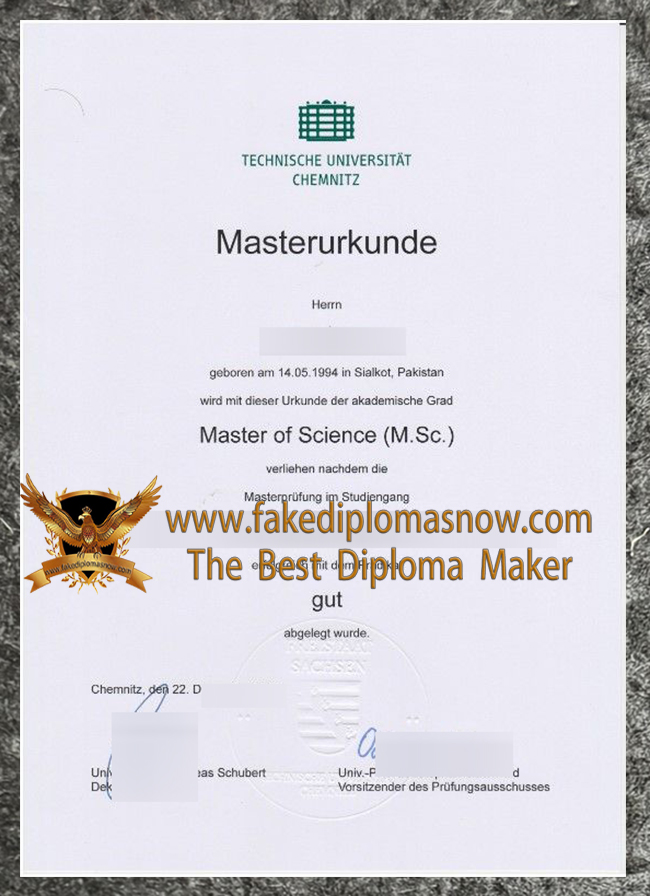
Technische Universität Chemnitz Masterurkunde
#Copy Technische Universität Chemnitz Masterurkunde.The Technical University of Chemnitz (Technische Universität Chemnitz), located in Chemnitz, western Saxony, Germany, is a public comprehensive university with a history of nearly 190 years. As a comprehensive technical university officially integrated in 1997, it is not only the third largest university in Saxony, but also a sanctuary of wisdom that perfectly blends profound historical heritage, cutting-edge research capabilities, and humanistic care.
Historical Development: From Industrial School to Modern University
The history of the Technical University of Chemnitz can be traced back to the “Royal Commercial School” (Königliche Gewerbeschule) founded in 1836, whose initial purpose was to train skilled professionals for the industrial development of the duchy. It underwent several reforms and name changes—becoming the State Technical Institute of Chemnitz in 1878, officially gaining technical university status in 1986, and integrating with the former Ztau Teachers’ College and other institutions between 1992 and 1997, ultimately forming the comprehensive university it is today, spanning eight faculties.
Located in a major industrial city in eastern Germany, this university has always resonated with the region’s economic development. Following German reunification in the 1990s, Chemnitz underwent structural transformation, and Chemnitz University of Technology (TU Chemnitz), with its continuously strengthening research capabilities and talent cultivation, has become a core engine driving the city’s transformation into a high-tech hub.
Size and Student Composition: Currently, TU Chemnitz has approximately 8,900 students and 2,400 faculty and staff, with a high proportion of international students, ranking among the highest in German public universities. Its academic structure is centered on engineering disciplines—engineering sciences (including computer science) account for 40.5% of the total student body, economics and social sciences 36.3%, natural sciences and mathematics 10.3%, and humanities and languages 9.9%, forming a unique “engineering-led, multidisciplinary” ecosystem characteristic of a technical university. Where to buy a Technische Universität Chemnitz degree?
In terms of teaching quality, TU Chemnitz is renowned for its exceptionally high student-to-faculty ratio, providing each student with ample academic resources and personalized guidance. This student-friendly attitude has earned it widespread public recognition—ranking it second in a poll of Germany’s most popular universities organized by Der Spiegel.
Three Core Competencies: From Materials to Human-Machine Collaboration
Chemnitz University’s research strategy focuses on three core areas, forming a comprehensive research system covering the entire chain from basic materials research and development to intelligent system integration and human-computer interaction:
1. Materials and Intelligent Systems: This field represents the university’s “hardcore technology” strength. The university’s Research Center for Nanofilm Materials, Architecture and Integration (MAIN) is a unique research facility in Europe, enjoying a high reputation in the global nanoelectronics field. In addition, the Center for Micro-Nano Technology (ZfM) in the Faculty of Electrical Engineering is equipped with a 1300-square-meter cleanroom, possessing complete 150mm and 200mm wafer processing capabilities, covering the entire process from thin film deposition and high-temperature processes to micro-nano structure formation.
2. Resource-Efficient Production and Lightweight Engineering: The university is a leading research center in the field of lightweighting. In 2012, its research focus on “Lightweight Structure Engineering” was successfully selected for the German Elite University Cluster Project, fully demonstrating its leading position in the field of mechanical engineering. Current research focuses on “green carbon fiber” and the circular economy, with its Carbon LabFactory in Boxberg receiving approximately €66 million in special funding from the federal and state governments. Replacement of Hochschule Kaiserslautern Urkunde 2026.
It is worth mentioning that Chemnitz is also an important base for well-known companies such as Volkswagen and Siemens, with a very close “industry-academia-research” chain between the university and industry. Students have the opportunity to directly engage with real-world industrial scenarios in automotive manufacturing and microelectronics during their studies.
3. Humans and Technology: This area embodies the university’s interdisciplinary characteristics. Based at the MeTech (Human-Machine Technology Research Center), Chemnitz University of Technology deeply integrates cognitive psychology, sensor technology, and artificial intelligence, offering unique interdisciplinary programs such as “Perception and Cognitive Psychology,” “Human Factors Engineering,” and “Neurorobotics.” In the winter semester of 2025/26, the university also established a “Microdegree” program in the field of computational neuroscience, providing learning opportunities for students outside the university.