
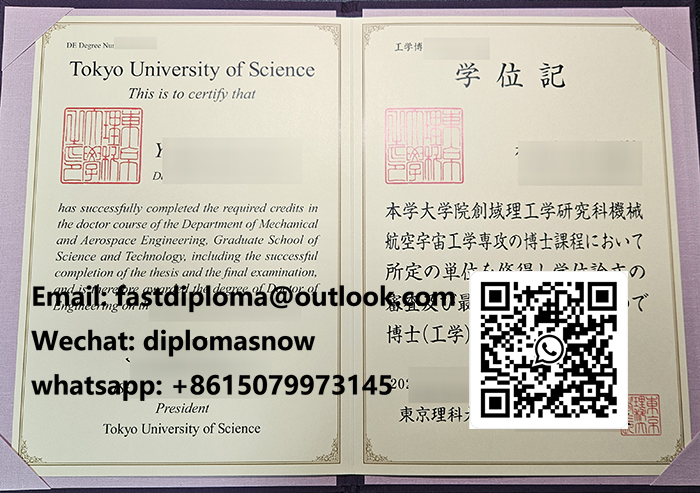
Tokyo University of Science degree
Located in Kagurazaka, Shinjuku Ward, Tokyo, is Tokyo University of Science, an institution whose lineage traces back to the “physics school” in Natsume Soseki’s novel *Boccchan*. Copy Tokyo University of Science degree. Founded in 1881, this private university occupies a unique and important position in Japan’s science and engineering higher education landscape due to its rigorous meritocratic educational philosophy and outstanding research capabilities.
Historical Heritage: From the Tokyo Physics Institute to the Modern University of Science
The history of Tokyo University of Science can be traced back to 1881, when 21 graduates of Tokyo Imperial University (now the University of Tokyo) founded the Tokyo Physics Institute with the ideal of popularizing natural science and promoting national development. This initial aspiration is encapsulated in the university’s motto, which remains in use today: “理学の普普をもって国运発展の基礎とする” (to use the popularization of science as the foundation for national development). In 1883, the training institute was renamed Tokyo Physics School, and it wasn’t until 1949, with the reform of the university system, that it was reorganized and named Tokyo University of Science.
This school held a special position during the Meiji period—at that time, only Tokyo University and Tokyo Physics School provided natural science education. The renowned modern Chinese scholar Wang Guowei also studied here, leaving a mark of cross-cultural exchange in the school’s early history.
“Merit-Based Education”: A Rigorous Tradition Known for High Repetition Rates
Tokyo University of Science is best known for its over-a-century-old “merit-based” educational policy. The core of this philosophy is: only students with genuine ability are allowed to graduate. Its most direct manifestation is that the first-year student retention rate once reached as high as 40%.
This tradition is unique in Japanese higher education. While the rigorous standards make graduation challenging, it is precisely this insistence on academic quality that makes Tokyo University of Science graduates highly sought after in the job market. The actual employment rate of graduates in March 2025 reached 94.0%, ranking first in Japan among large universities with more than 4,000 graduates. Major employment destinations include top Japanese companies such as Fujitsu, Hitachi, Sony, and Canon, as well as the Tokyo Metropolitan Government.
Academic Structure and Degree Types: Undergraduate and Graduate School System
Tokyo University of Science has 8 faculties and 10 graduate schools, forming a complete system for awarding degrees in science and engineering.
Undergraduate Degrees (Bachelor’s)
The faculties cover multiple fields including science, engineering, pharmacy, basic engineering, and business administration. Where to buy a Tokyo University of Science diploma? The Faculty of Science, Division 1 includes departments of mathematics, physics, applied physics, and chemistry; the Faculty of Engineering, Division 1 covers departments of architecture, electrical engineering, mechanical engineering, and business administration. It is worth noting that the Faculty of Science, Division 2, and the Faculty of Engineering, Division 2, are evening programs for working professionals, which is quite rare among private universities.
Graduate Degrees (Master’s & Doctoral) The Graduate School awards Master’s and Doctoral degrees, covering fields such as Natural Sciences, Engineering, Pharmaceutical Sciences, Science and Engineering, Basic Engineering, Business Administration, and Life Sciences. Furthermore, the Graduate School of Integrated Science and Technology Management offers specialized professional degree programs, such as Technology Management (MOT) and Intellectual Property Strategy (MIP), cultivating highly skilled professionals with strong practical abilities. Tokyo Institute of Technology degree sample, buy a TIT diploma online.
Research Strength and Alumni Achievements Tokyo University of Science ranks among the top private universities in Japan in terms of research strength. In the 2025 All-Japan High School Graduate Guidance Teachers Survey, it ranked first among private universities in the “Universities with High Research Strength” category for the 10th consecutive year. In the THE World University Rankings, it ranks 3rd among private universities in Japan in terms of research strength.
Regarding alumni achievements, Professor Satoshi Ōmura, the 2015 Nobel Laureate in Physiology or Medicine, is the most prominent. He received his Master’s degree from Tokyo University of Science in 1963 and his Doctor of Science degree in 1970, becoming the university’s first Nobel laureate. Business alumni are equally distinguished; current presidents of renowned companies such as Suzuki and Fujitsu are graduates of the university, which ranks 28th globally in the list of alma maters for CEOs.
Campus and Campus Life
Tokyo University of Science has four campuses: Kagurazaka and Katsushika campuses in Tokyo, Noda campus in Chiba Prefecture, and Nagamanbe campus in Hokkaido. The main campus, Kagurazaka, is located in the heart of Shinjuku Ward and carries on a historical legacy dating back to its “physics school” days. Students in the Faculty of Basic Industrial Engineering study their first year at the Nagamanbe campus in Hokkaido before transferring to the Noda campus to complete their studies.
In short, Tokyo University of Science is a private science and engineering university where “rigor” is ingrained in its DNA. It offers not only bachelor’s, master’s, or doctoral degrees in science, engineering, pharmacy, or business, but also a dual test of academic ability and willpower. Here, “graduating successfully” is itself a certificate highly recognized by top Japanese companies, and “meritocracy” is transformed from a slogan into a tangible source of confidence for graduates to continuously create value in academia and industry.