
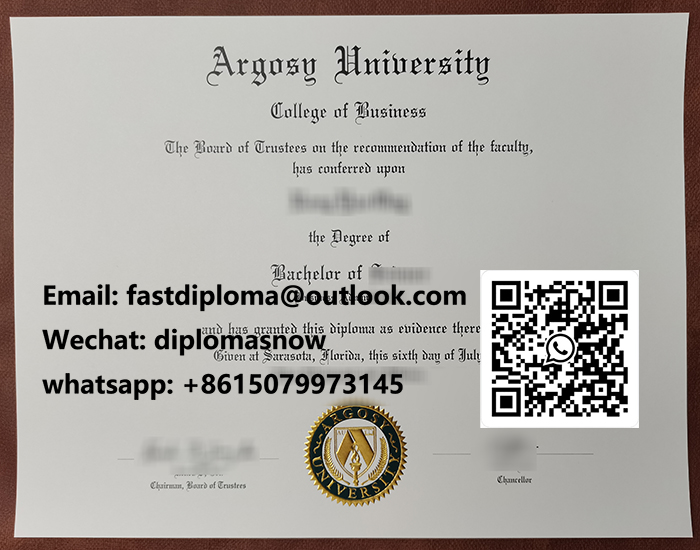
Argosy University degree
Argosy University: From Educational Giant to Sudden Collapse
Argosy University was once one of the largest for-profit private university systems in the United States, boasting 28 campuses across the country and a large online education division at its peak. Buy an Argosy University degree. Make an Argosy University diploma. The university primarily focused on applied education in psychology, business, education, and health sciences, particularly its graduate education in psychology, which was once highly regarded in the field. However, this “educational behemoth” collapsed in March 2019 due to allegations of financial irregularities and fraud, leaving behind approximately 8,800 students and massive debt disputes.
History and Mergers
Argosy University’s history can be traced back to three specialized institutions in the second half of the 20th century. Its core components include the University of Sarasota (founded in 1969, with a focus on business and education), the Medical Institute of Minnesota (founded in 1961, focusing on healthcare training), and the American School of Professional Psychology, founded by psychologist Michael Markovitz. Markovitz later founded the Argosy Education Group, which subsequently acquired the aforementioned institutions.
In 2001, the Argosy Education Group was acquired by Education Management Corporation (EDMC), then the second-largest higher education company in the United States. That same year, the three institutions were formally integrated and renamed Argosy University. This merger defined Argosy University’s unique DNA: combining academic focus (psychology), business operations (business education), and vocational training.
Academic Structure and Peak Period
Before its closure, Argosia University comprised several colleges, including the College of Psychology and Behavioral Sciences, the Business School, the College of Education, the College of Health Sciences, and an undergraduate graduate program. It also included the Western State College of Law and parts of the former Art Institutes campus.
Its greatest strength lay in psychology. Argosia supported one of the largest graduate student populations in the United States, offering Master’s and Doctoral (Psy.D.) degrees in areas such as clinical psychology, counseling psychology, and marriage and family therapy, attracting a large number of professionals seeking licensing. In addition to its physical campuses, Argosia had a well-developed online education system, offering courses at multiple levels from associate’s to doctoral degrees. In 2012, the university’s student population peaked at approximately 24,800. How long to obtain an Abilene Christian University diploma?
Copy Argosy University degree online
Despite its large size, Argosia University’s operating model was highly controversial; it was essentially a for-profit enterprise operating around federal student loans.
As early as 2009, students at the Dallas campus filed a lawsuit accusing admissions officers of misleading students into believing that the American Psychological Association (APA) accreditation was imminent, despite the university not yet having received accreditation. In 2010, an undercover report by the U.S. Government Accountability Office (GAO) named Argosi University, alleging that its admissions officers made “deceptive or misleading” statements. In 2013, EDMC agreed to pay $3.3 million to settle allegations of “deceptive marketing” in Colorado and Texas, but did not admit liability [citation:27]. Make a diploma.
Collapse and Closure (2017-2019)
This is Argosi University’s darkest and most well-known chapter. In 2017, EDMC, mired in financial crisis, sold Argosi University to Dream Center Education Holdings (DCEH), a religious organization in Los Angeles. This takeover not only failed to save the school but accelerated its demise.
DCEH lacked experience in operating such a large-scale university system and quickly experienced severe financial chaos. In early 2019, media reports revealed that Argosia University had failed to distribute over $9 million in federal student aid. Subsequent investigations showed the deficit was far more severe than initially thought—the university had misappropriated $13 million in student loans intended for students to pay staff salaries and other operating costs.
On February 27, 2019, the U.S. Department of Education announced the termination of federal funding to Argosia University. Since nearly 90% of the university’s revenue relied on federal funding, this move effectively sealed its fate. On March 8, 2019, all Argosia University campuses officially closed.
Consequences and Aftermath: The sudden closure dealt a devastating blow to students and faculty. Many students were forced to drop out with only weeks or months left before graduation, not only failing to obtain their degrees but also facing difficulties transferring their credits to other accredited institutions due to issues with credit recognition. Because Argosia used national accreditation, while many traditional public universities use regional accreditation, a large number of credits could not be transferred.
The handling of student loans became a long-standing legacy issue. Affected students filed a “Borrower Defense to Repayment” petition, accusing the school of fraud. In 2022, as part of a class-action settlement, Argosi University was listed as an institution with “material misconduct,” providing some students with grounds for loan forgiveness. However, this process was fraught with difficulties, and many students were still awaiting repayment decisions from the Biden administration as late as 2025, burdened with hundreds of thousands of dollars in debt and facing financial hardship.
The Argosi University case serves as a stark negative example of the challenges facing for-profit education in the United States. Its history, from rapid expansion to collapse, reveals how, driven by capital, some higher education institutions have strayed from their educational mission, prioritizing profits over student interests, ultimately harming not only the futures of countless students but also eroding public trust in the private education accreditation system.