
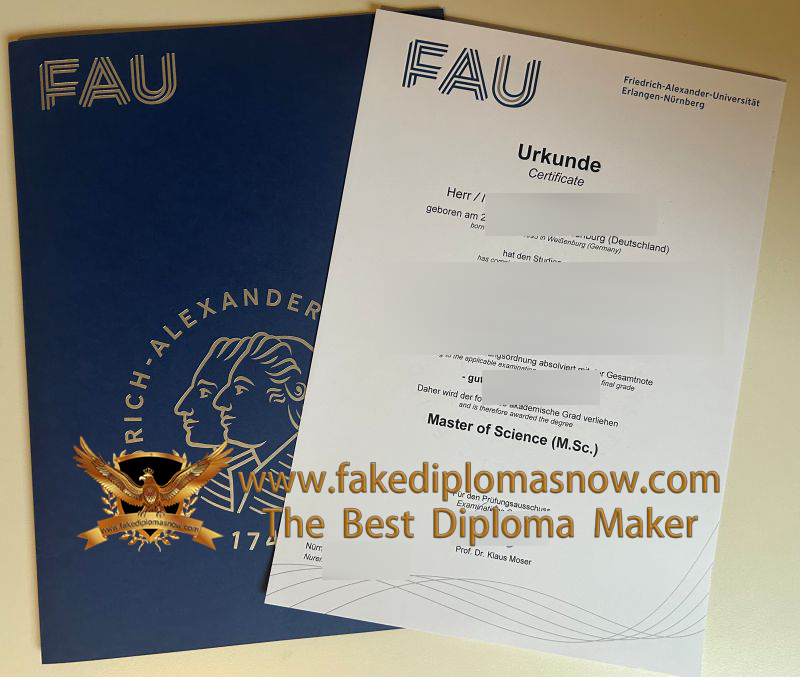
FAU Erlangen-Nürnberg Urkunde
The University of Erlangen-Nuremberg (FAU) is the second largest public university in Bavaria, Germany, with its origins dating back to 1742. Copy FAU Erlangen-Nürnberg Urkunde. As a public research university with an exceptionally comprehensive range of disciplines, FAU is renowned for its “broadest range of specializations,” with its degree system covering almost all fields from the humanities and arts to cutting-edge engineering. Currently, the university has campuses in Erlangen and Nuremberg, with over 40,000 registered students. FAU’s degree system not only follows the standard German three-tier degree system but is also unique due to its rich interdisciplinary options and strong research capabilities.
I. Bachelor’s Degree: Laying a Broad and Solid Academic Foundation
A bachelor’s degree at FAU is the cornerstone for students to advance in their professional fields, typically requiring three years of study. The university offers over 70 undergraduate programs, awarding different types of bachelor’s degrees, mainly divided into two categories:
Bachelor of Arts (B.A.): Primarily awarded to students in the humanities, social sciences, theology, and related fields. Specific majors include Archaeological Science, Art History, Library Science, Business and Economics, and Chinese Studies.
Bachelor of Science (B.Sc.): Primarily awarded in natural sciences, engineering, and some social sciences. Strong programs include Artificial Intelligence (AI), Autonomy Technologies, Chemical and Biological Engineering, Clean Energy Processes, Data Science, and Computer Science.
A key feature of FAU’s undergraduate education is the ease of interdisciplinary learning. For example, computer science students can minor in business administration, while biology students can study in specific medical fields. This flexibility aims to cultivate well-rounded individuals. Furthermore, the university offers a range of undergraduate programs taught entirely in English, such as International Business Studies and Artificial Intelligence, attracting numerous international students.
II. Master’s Degrees: Focusing on In-Depth Research and International Perspectives
After obtaining a bachelor’s degree, students can continue their studies at FAU to pursue more advanced and specialized master’s degrees, typically lasting two years. FAU offers over 200 master’s degree programs, making it one of the universities with the most diverse degree programs in Germany. Ostfalia Hochschule für angewandte Wissenschaften Master Urkunde.
The types of master’s degrees are more diverse, mainly including:
Master of Science (M.Sc.): This is the most common master’s degree, covering the vast majority of engineering and natural science disciplines, such as advanced materials and processes, artificial intelligence, data science, and molecular medicine.
Master of Arts (M.A.): Awarded in the humanities and some social science disciplines, such as ancient languages and cultures, digital humanities, development economics, and international studies.
Professional Master’s Degrees: Such as the Master of Business Administration (MBA), especially MBA programs combining cutting-edge fields such as “Digital Business and Artificial Intelligence.”
It is worth mentioning that FAU offers a considerable number of master’s programs taught entirely in English, ranging from artificial intelligence and optical technology to molecular medicine, making it one of the most international universities in Germany and providing international students with direct access to Germany’s top research fields.