
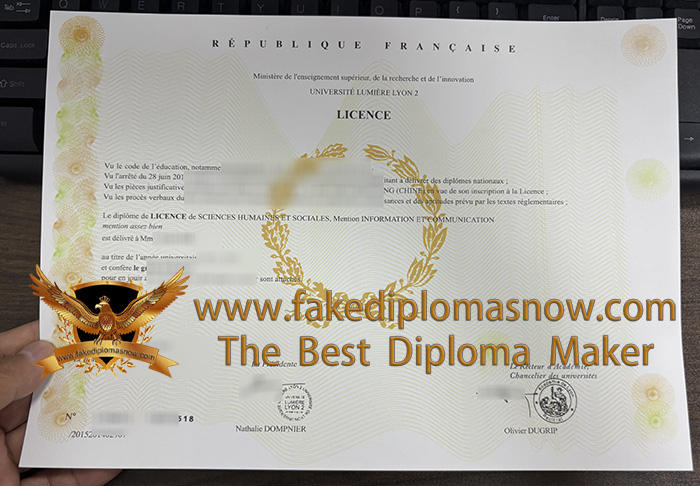
Lumière University Lyon 2 diploma
A Comprehensive Introduction to Université Lumière Lyon 2,Buy a Lumière University Lyon 2 diploma.
I. University Overview
Université Lumière Lyon 2 (abbreviated as Lyon 2) is a renowned public university specializing in humanities and social sciences in France, located in Lyon, France’s second-largest city. Founded in 1973, its name “Lumière” pays homage to the Lumière brothers, the inventors of modern cinema technology, reflecting the university’s commitment to humanistic spirit and innovative thinking. Copy Lumière University Lyon 2 degree.
As the second-ranked university in France for literature, languages, and humanities and social sciences, Lyon 2 is a founding member of the Lyon Higher Education and Research Cluster. The university has nearly 27,000 students spread across two main campuses: Berges du Rhône and Porte des Alpes. Adhering to the core values of humanism, openness, inclusivity, and democratic participation, the university is committed to high-quality teaching and cutting-edge research.
II. Faculty and Academic Disciplines
2.1 Teaching Institutions
The University of Lyon 2 comprises 13 teaching and research units, encompassing 6 faculties, 5 research institutes, 1 university technical college, and 1 international French language learning center. This comprehensive institutional system ensures the university’s all-round coverage in the humanities and social sciences.
2.2 Four Core Academic Areas
The school’s curriculum revolves around four main educational research directions:
First Area: Arts, Literature, and Languages
Covering majors such as Music and Performing Arts, Film and Visual Arts, Media and Cultural Studies, Modern and Classical Literature, and Creative Writing
The Language Institute offers 12 languages, from German, English, Arabic, and Chinese to Spanish, Italian, Portuguese, and Russian.
It houses the International French Language Learning Center (CIEF), providing French language and culture training specifically for students from non-French-speaking countries.
Second Area: Law, Economics, and Management
The Law School offers high-quality courses in law, public administration, and socio-economic management, and has signed over 40 international cooperation agreements with foreign institutions.
The School of Economics and Management offers courses in business, economics, management, banking, finance, transportation, and logistics, with high graduate employment rates and accreditation from the French Higher Education Evaluation Commission (HCERES).
Third Area: Humanities and Social Sciences
Anthropology, Sociology The university offers programs in Geography, Political Science, Applied Mathematics and Computer Science (for humanities and social sciences), Gender Studies, and Social Development.
The Faculty of Geography and Planning comprises five departments: Geography, History, Art History and Archaeology, Tourism, and Urban Planning.
The Faculty of Psychology offers specializations in Clinical Psychology, Developmental Psychology, Social Psychology, Work and Organizational Psychology, Cognitive Psychology, and Neuropsychology.
The Faculty of Educational Sciences offers courses in Education, Adult Education, Special Education, and Disability Studies, and also provides exam preparation training for the French primary and secondary school teacher qualification exams (CRPE, CAPES, Agrégation).
Fourth Area: Science, Technology, and Health
The Faculty of Communication offers courses in Information and Communication Science, Computer Science and Statistics, Computer Graphics and Multimedia, Journalism, Video Game Culture, and Fashion Studies.
The Institute of Labour offers interdisciplinary courses covering contemporary labor issues such as labor law, international worker mobility, discrimination and inequality, and ergonomics.
III. Curriculum and Teaching Model
3.1 Credit and Semester System
Lyon II University adopts the European Credit Transfer System (ECTS). Each academic year is divided into two semesters: the Autumn Semester (September-January) and the Spring Semester (January-June). Each semester awards 30 ECTS credits.
Course levels are as follows:
Undergraduate Year 1 (Licence 1) to Year 3 (Licence 3)
Master’s Year 1 (Master 1) to Year 2 (Master 2)
Doctoral Level
3.2 Teaching Formats
The university employs two main teaching formats:
Large Lectures (CM – Cours Magistral): Conducted in a lecture hall, where professors explain the core theories and knowledge framework of the course.
Small Group Tutoring (TD – Travaux Dirigés): Conducted in a regular classroom, using group discussions, exercises, and case studies to help students deepen their understanding.
For some courses, the two teaching formats are intertwined; students must attend both CM and TD to complete the course.
3.3 International Learning Pathways
MINERVE International Program: This program aims to provide undergraduates with an international learning experience. Courses are taught in German, Spanish, or Italian by native-speaker teachers. Completion of this program prepares students for subsequent international exchanges and double degree programs. Applicants are required to have a B2 level of English proficiency.
Interdisciplinary Language Learning: The university’s language center offers 12 language courses, taught in tiers according to level, including German, English, Arabic, Catalan, Chinese, Spanish, French (for non-native speakers), interlingual comprehension, Italian, Portuguese, Swedish, and Russian.
3.4 Typical Course Examples
Geography and Planning/History Double Major (L2): This course aims to develop students’ ability to understand territorial mechanisms and public policy issues. Key features include:
Fieldwork: Students participate in field research throughout the year, culminating in a week-long field trip in the second semester, providing in-depth engagement with local stakeholders.
Methodological Training: Mastering modern geographical analysis tools such as surveys and interviews, statistical analysis, Geographic Information Systems (GIS), and remote sensing.
Interdisciplinary Integration: Combining spatial analysis skills from geography with critical thinking from history.
Graduates can pursue a professional master’s degree or take the secondary school history-geography teacher qualification exam.
Art History and Archaeology/Literature Double Major (L2): This course is designed for students aiming for careers in culture, heritage management, archaeology, and related fields. Features include:
Fieldwork: Gain professional practical experience through internships in public institutions, private institutions, or participation in fieldwork at the university’s archaeological excavation school.
Dual-Discipline Training: Enhance literary literacy and broaden multidisciplinary perspectives based on art history/archaeology.
IV. Research Strength
Lyon II University is a leading research institution in the humanities and social sciences in France, boasting:
33 research laboratories
Over 600 faculty-researchers
820 doctoral students (2024-2025 academic year)
Two major research centers: the Center for Humanities and Social Sciences (MSH-LSE) and the Consortium for the Study of Ancient Societies – Jean-Puyau House of the Orient and the Mediterranean (MOM)
Lyon University Press (PUL): Focuses on academic publishing in literature and the humanities and social sciences.
The university’s research strategy emphasizes interdisciplinary dialogue, open science, international collaboration, and public science communication, actively participating in research collaborations within the European BAUHAUS4EU university alliance.
V. Internationalization and Cooperation
5.1 Global Cooperation Network
With an open and inclusive approach, Lyon 2 University has signed 560 cooperation agreements with 370 partner institutions in 60 countries worldwide. In the 2023-2024 academic year, 536 students participated in exchange programs abroad for one semester or one year, and 274 students completed overseas internships.
The university is a member of the BAUHAUS4EU European University Alliance, a network of 10 European higher education institutions encompassing 124,000 students and 10,000 faculty and staff, dedicated to building innovative models for the future of higher education.
5.2 International Student Composition
18% of the student body is international, admitted either through exchange programs or direct entry. International students come from 93 countries, bringing rich cultural diversity to the campus.
5.3 Course Selection Instructions for Exchange Students
For exchange students, Lyon 2 University allows cross-faculty and cross-year course selection (from first-year undergraduate to second-year master’s students). However, please note that some course categories (such as the third year of a professional undergraduate program, university diploma courses, and specialized courses) are not open to exchange students. Due to the limited number of English-taught courses, the university recommends that exchange students have a French proficiency level of B2 or above.
VI. International French Language Learning Center (CIEF)
The International French Language Learning Center (CIEF) at Lyon 2 University is one of the oldest French language centers in France, established in 1945. It is affiliated with ADCUEFE (Association of Directors of University French Language Learning Centers) and has signed the ADCUEFE/Campus FLE Quality Charter.
CIEF specifically provides French language and culture training for non-native French speakers. Course content includes:
Intensive French courses (starting in February and September each year)
French proficiency test preparation
Language bridging support for students planning to enter the French higher education system
This center is the starting point for many Chinese students choosing to study at Lyon 2 University.
VII. Conclusion Lyon 2 University is a top-tier French public university specializing in the humanities and social sciences. With its comprehensive disciplinary coverage, rigorous teaching system, extensive international exchange network, and outstanding research capabilities, the university provides students with a high-quality learning and research platform. Whether pursuing art, literature, languages, law, economics and management, social sciences, or communication and information technology, students can find an academic path that suits them here. French as the primary language of instruction makes Lyon 2 an ideal choice for international students who wish to deeply experience the French academic and cultural traditions.