
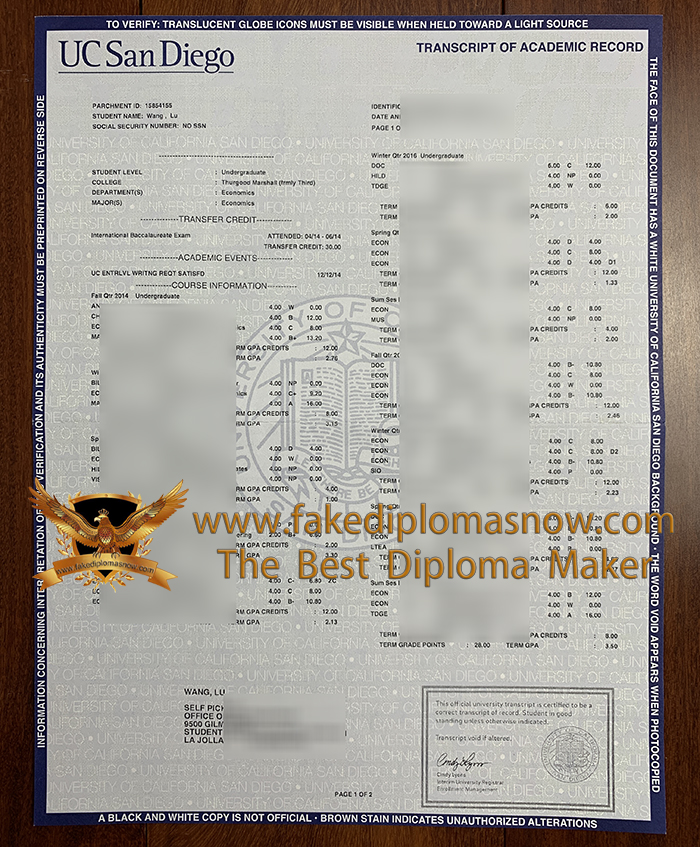
UC San Diego transcript
UC San Diego transcript sample. The University of California, San Diego (UCSD) uses a quarter system, with each academic year divided into three seasons: fall, winter, and spring. Each season lasts approximately 12-13 weeks, offering a fast-paced and efficient learning environment. Students can choose 3-4 courses per semester, earning 12 credits. Course selection is highly flexible, with undergraduates, graduate students, and visiting students able to freely combine courses from hundreds of academic disciplines.
Undergraduate Courses: Comprehensive Coverage and Specialized Streams
UCSD offers over 140 undergraduate majors, with a curriculum structured around a dual axis of “general education foundation + specialized in-depth study.” The Jacobs School of Engineering offers specializations in aerospace, bioengineering, computer engineering, mechanical engineering, and structural engineering. Mechanical engineering is further subdivided into six specializations, including control and robotics, fluid mechanics, and renewable energy. Structural engineering covers precise tracks such as aerospace structures, civil structures, geotechnical engineering, and health monitoring. The School of Biological Sciences’ curriculum spans the entire spectrum from molecules and cells to organisms and ecosystems. With proximity to institutions such as the Salk Institute and the Scripps Institution of Oceanography, undergraduates can directly enroll in world-class courses in marine biology and earth sciences. The Bachelor of Science in Data Science is an elective major. Core courses include DSC 10 (Principles of Data Science), DSC 20 (Programming and Data Structures), DSC 30 (Algorithms), DSC 40 (Theoretical Foundations), and DSC 80 (Practice), offered from freshman to senior year.
Psychology and Public Health: An Applied Curriculum Cluster. The Department of Psychology offers both B.A. and B.S. tracks. The B.S. track is further divided into six specializations: Clinical Psychology, Cognitive Psychology, Developmental Psychology, Human Health Psychology, Perception and Feeling, and Social Psychology. It also offers a joint major in Business Psychology and Cognitive Behavioral Neuroscience in collaboration with Cognitive Science. The curriculum emphasizes experimental design and data analysis. The Herbert Wertheim School of Public Health will establish a new Bachelor of Science in Public Health in Fall 2026, offering six specializations: Biostatistics, Climate and Environmental Science, Community Health Science, Epidemiology, Health Policy and Management Science, and Medical Science. Courses are offered in collaboration with the main campus and the Southwestern College border campus.
Graduate Programs: Research-Oriented and Career-Oriented
Graduate programs emphasize methodological training and interdisciplinary integration. The MSc in Biostatistics requires 56 credit hours, with core courses including theoretical statistics, biomedical data analysis, and reproducible research practice. A mandatory “Practicum” is required, where students must complete a statistical analysis report and oral defense from a real biomedical collaborative project. The Department of Nanoengineering offers MS and PhD programs in Chemical Engineering and Nanoengineering. The MS application deadline is July 15, 2026 (early applications January 14). GRE is optional. Courses cover advanced materials, semiconductor processes, and molecular simulations. Visiting Scholar Credit Programs are open to international students to all undergraduate and graduate programs across the university, excluding those offered by the Reddy’s School of Business. Language requirements include TOEFL 79/IELTS 6.5 and a GPA of 2.8+.
Certificate Programs and Interdisciplinary Supplements
The TEFL Advanced Professional Certificate requires completion of three consecutive quarters and includes OPT internship eligibility. The Business English program invites local CEOs to teach and organizes company visits. The summer semester course preview shows that departments such as Anthropology, Global Health, Ethnic Studies, Structural Engineering, and Physics offer more than 100 elective courses ranging from introductory to advanced, fully reflecting UCSD’s “general education and professional education integration” curriculum philosophy.