
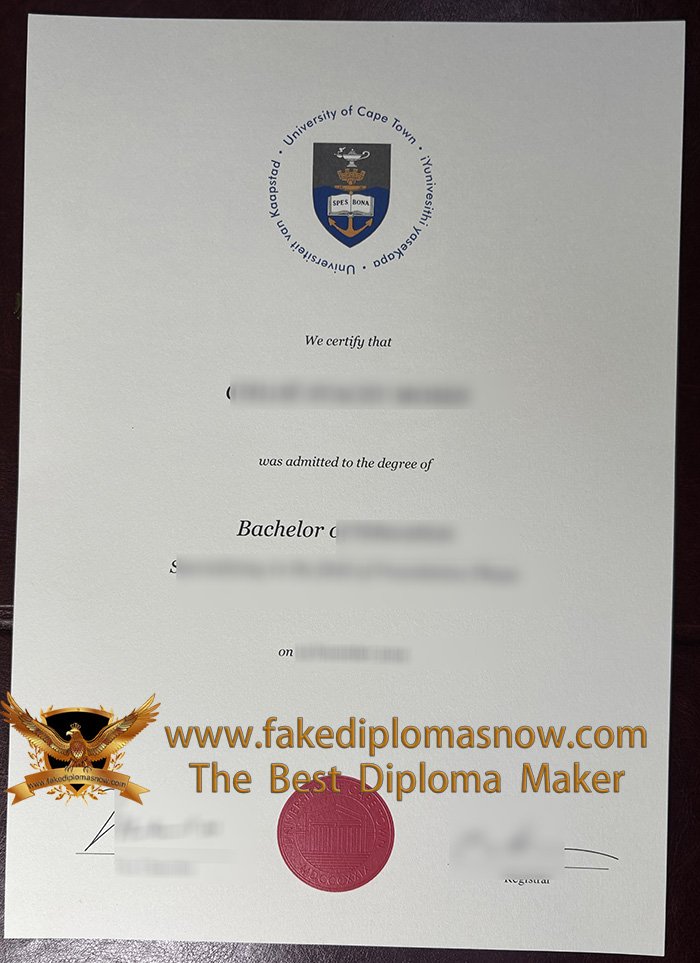
University of Cape Town degree
Nestled on the slopes of Devil’s Peak at the foot of Table Mountain stands a prestigious academic institution that resonates with the history of South Africa—the University of Cape Town. As the oldest and highest-ranked university on the African continent, it not only carries nearly two centuries of intellectual heritage but also leaves an indelible mark on pivotal moments in human history. Buy a University of Cape Town degree online. Make a diploma.
Historical Development: From Colonial College to Beacon of Freedom
The University of Cape Town’s history dates back to 1829, its predecessor being “South Africa College,” initially a boys’ college providing education for the children of missionaries. In 1841, the college moved to the foot of Devil’s Peak on the ridge of Table Mountain, thus forging an inseparable bond with this iconic mountain. In 1890, the college began admitting women, becoming one of the first co-educational institutions of higher learning in South Africa. In 1918, through a parliamentary act, South Africa College officially became the University of Cape Town, becoming the first institution in sub-Saharan Africa to achieve university status.
During the apartheid era, the University of Cape Town, with its tradition of free and open academics, became one of the few higher education institutions in South Africa to remain open to students of all races, and a crucial bastion in the fight against apartheid. This tradition continues to this day, with black and white students now each comprising roughly half of the student body, truly realizing the ideal of educational equity.
Academic Strength: Africa’s Leading Comprehensive University
The University of Cape Town currently has approximately 29,000 students, one-third of whom are postgraduate students, and awards over 3,000 undergraduate degrees annually. The university comprises six faculties covering humanities, business, engineering and the built environment, health sciences, law, and science, offering comprehensive education from undergraduate to doctoral levels.
The Faculty of Health Sciences is a source of pride for the University of Cape Town and indeed for all of Africa. Its medical school, founded in 1912, is the oldest medical school in sub-Saharan Africa. In 1967, Professor Chris Barnard of the affiliated hospital performed the world’s first human heart transplant, forever etching the University of Cape Town’s name into medical history. Today, the university boasts 33 of the 81 accredited research units across the university and consistently ranks among the top 100 globally in the QS World University Rankings by Subject for Medicine.
The Business School is equally prestigious, with its Executive MBA program ranking among the top globally in alumni satisfaction according to the Financial Times in 2024. The Law School is a cradle of South Africa’s top legal talent and houses a refugee rights legal clinic dedicated to serving vulnerable groups in society.
The Faculty of Science has produced numerous Nobel laureates: Aaron Cormac (1979 Nobel Prize in Physiology or Medicine for CT scanning technology) and Alan Kluge (1982 Nobel Prize in Chemistry for crystal electron microscopy) are both graduates. Furthermore, Nobel laureate J.M. Coetzee in Literature and Nobel Peace Prize laureate Ralph Bench are also distinguished alumni of the University of Cape Town.
Research Innovation: Leading the Way in Africa The University of Cape Town is not only an academic research center in Africa but also an indispensable force in the global research landscape. In 2024, four scholars were selected for Clarivate Analytics’ “Highly Cited Researchers” list, ranking among the top 1% of most influential scholars globally.
In the field of health research, Kaida University has achieved remarkable results. The Lenacapavir clinical trial, in which Professor Linda-Gail Becker’s team participated, made groundbreaking progress in HIV prevention and was named a Breakthrough of the Year for 2024 by *Science* magazine, demonstrating Africa’s leading role in scientific research and driving global innovation. The H3D Drug Discovery and Development Center received a $7.2 million grant from the Bill & Melinda Gates Foundation to lead the establishment of the African Continental Drug Discovery Accelerator Network, fostering local pharmaceutical innovation capabilities.
In the field of neuroscience, Dr. Rachael Dangarembizi established Africa’s first research laboratory for cryptococcal meningitis. This fungal meningitis is a leading cause of death among HIV/AIDS patients in sub-Saharan Africa, yet it has long been neglected by the global research community. Her work filled a gap in the field and earned her the 2024/2025 TW Kambule-NSTF Emerging Researcher Award—one of South Africa’s highest honors in science, engineering, technology, and innovation.
In the field of sustainable development, Cape Town students shone at the 2025 Greenovate Awards, sweeping the top spots in the Real Estate and Engineering categories, as well as the EDGE Award for Design Excellence. Among these achievements, a project researching urine recycling for fertilizer production will be further developed and implemented at Cape Town Stadium, demonstrating the immense potential of academic research to solve real-world problems.
Campus and City: The University of Cape Town’s main campus sits on the slopes of Devil’s Peak at the eastern foot of Table Mountain, overlooking the city of Cape Town and Table Bay. The campus buildings are nestled into the hillside, blending Victorian and modern architectural styles. Historical landmarks such as Groot Schul Hospital (the site of the world’s first heart transplant) and Moster Windmill are within walking distance of the campus.
As a highly international university, Cape Town students come from over 70 countries worldwide. This multicultural campus atmosphere, coupled with Cape Town’s natural and cultural resources as a globally renowned tourist city, allows Cape University students to pursue academic excellence amidst magnificent natural landscapes.
In conclusion, the University of Cape Town’s motto is “Spes Bona” (Good Hope). For nearly two centuries, this university has never failed to live up to this aspiration—from fighting apartheid to combating AIDS, from exploring human origins to promoting green transformation, the University of Cape Town has consistently stood at the forefront of change in Africa and the world. For every student studying here, this “university at the foot of Table Mountain” offers not only world-class education, but also a vision and mission: to become a “good hope” driving progress in Africa and humanity.