
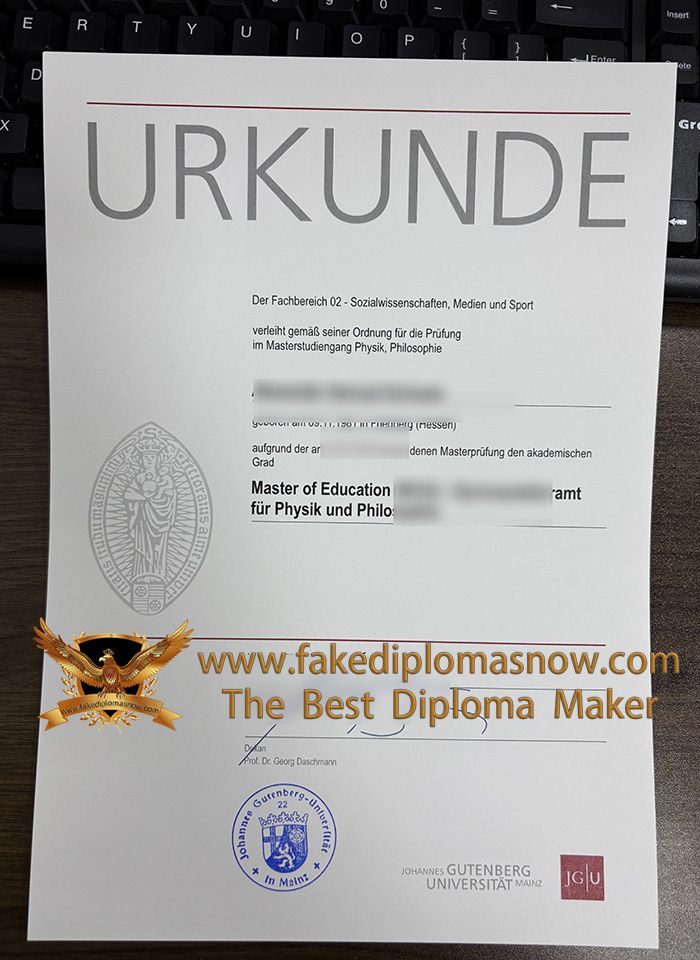
Johannes Gutenberg-Universität Mainz Urkunde
Johannes Gutenberg University Mainz: A Fusion of the Glory of Movable Type Printing and Modern Science,Copy Johannes Gutenberg-Universität Mainz Urkunde. Make a Johannes Gutenberg-Universität Mainz diploma. Buy a diploma online.
In Mainz, a pearl city on the Rhine River in Germany, stands a renowned university that blends the ink-scented traditions of the Renaissance with the brilliance of contemporary science—Johannes Gutenberg University Mainz. As a core member of the German U15 University Alliance, this university, named after the father of the European printing revolution, carries the mission of “knowledge dissemination” and is one of the ten largest universities in Germany today.
A Tumultuous Revival: A Legend Spanning Five Centuries
The history of the University of Mainz is a condensed version of modern European history. Its roots can be traced back to 1477, founded by Archbishop Dieter von Isenberg with the approval of Pope Sixtus IV. It was one of the largest Catholic universities in Germany at the time, renowned for its theological studies.
However, the tides of history brought an end in 1798—Napoleon’s French army occupied Mainz, forcing the university to close. For nearly a century and a half afterward, the city lost its university. It wasn’t until 1946, after the end of World War II, that the university officially reopened as the Johannes Gutenberg University, with the support of the French occupation government (particularly General de Gaulle). This rebirth was significant: the name Gutenberg signified the university’s mission as a “center for the dissemination of knowledge”; its founding in 1946 also marked Mainz’s rise as the scientific center of the Rhineland-Palatinate capital. In 2005, the university completed a structural reform, resulting in the 11 faculties structure it maintains today.
Discipline Matrix: Breadth from Theology to mRNA
As a comprehensive university, it currently has approximately 32,000 to 37,000 students (including about 11%-13% international students), offering over 100 majors, covering almost all academic fields.
The faculties of the University of Mainz embody a perfect blend of classical and modern elements. On the one hand, it retains a profound foundation in traditional humanities disciplines such as theology and philosophy; on the other hand, it has achieved remarkable success in the natural and life sciences. Uniquely, it is one of the very few comprehensive universities in Germany that incorporates fine arts, music, and sports into its academic system, forming a truly balanced approach to humanities and arts.
The Germesheim Institute of Translation and Interpretation is a globally renowned flagship institute of the University of Mainz. As one of Germany’s three major translation institutes, it is located in Germesheim, about 120 kilometers from the main campus, offering training in interpreting and translation in dozens of languages, including major European languages and Chinese. It is one of the cradles of interpreters for the EU and the UN.
Scientific Hub: A Campus Surrounded by Major Institutions
The most unique charm of the University of Mainz lies in its highly concentrated cluster of non-university research institutions—these top institutions representing the highest level of research in Germany are either located on campus or within a few kilometers:
The Max Planck Institute for Chemistry and the Institute for Polymer Research: Located directly on the university campus, they are world leaders in climate chemistry and polymer materials.
The Helmholtz Institute for Mainz: Focuses on nuclear physics and materials science. Don’t panic if you lose your Hochschule Mittweida Urkunde.
The Fraunhofer Institute for Microtechnology and Microsystems: Drives application-oriented research and development in microelectronics and sensors.
The Institute for Molecular Biology (IMB): Renowned in epigenetics and aging research.
This cluster ecosystem of “university + top external institutions” benefits from the Mainz Science Alliance established in 2020, making Mainz a world-class research center for chemistry, materials science, immunology, and quantum physics. The university has also entered the German Elite University Initiative framework, receiving tens of millions of euros in funding, based on its outstanding research performance.
Campus Features and City Connections
Unlike many German universities scattered throughout the city, the University of Mainz is one of the few universities in Germany with an independent, enclosed campus. Located in the southeast of the city, the campus boasts over 150 buildings, including large teaching and research facilities housing a particle accelerator, a botanical garden, and a teaching hospital.
In terms of city life, Mainz, as the capital of Rhineland-Palatinate, is located across the Rhine River from Frankfurt and Wiesbaden, in the heart of the Rhine-Main metropolitan area. It is home to the global headquarters of ZDF (German television channel) and the Schott Glass Group, offering students unique internship opportunities in journalism and materials science.
In summary, Johannes Gutenberg University Mainz is a university that combines historical depth with innovative dynamism. Originating as a theological seminary in the 15th century, it has become a leading center in mRNA vaccine technology (its partner institution, BioNTech, is located within the Mainz Science Alliance) and quantum materials in the 21st century. For students seeking academic breadth, valuing industry integration, and desiring immersion in a world-class scientific community, JGU offers an unparalleled “academic life on the banks of the Rhine.”