
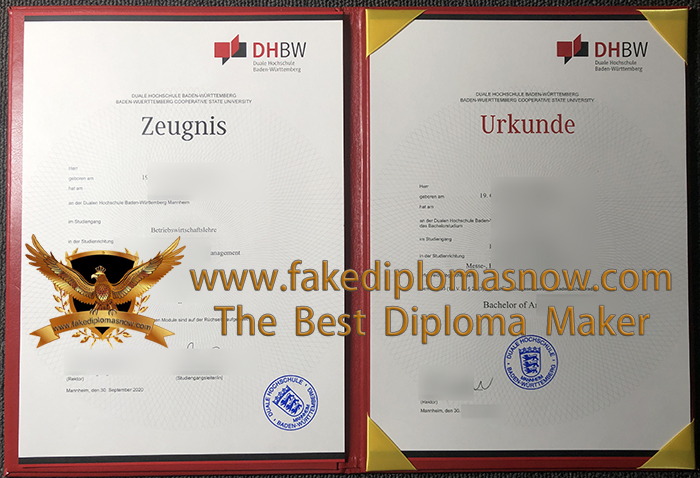
DHBW Urkunde und Zeugnis
DHBW Urkunde und Zeugnis from Baden-Württemberg. The Baden-Württemberg Dual University of Applied Sciences (DHBW) is Germany’s first and largest dual university, headquartered in Stuttgart, the capital of Baden-Württemberg. Its history traces back to the Baden-Württemberg Vocational College founded in 1974. It was officially upgraded to a university in 2009, becoming a unique and innovative force in the German higher education system.
Historical Origins: Innovation Driven by Business Needs
DHBW’s creation stemmed from the urgent need of businesses for highly skilled, application-oriented professionals. In the early 1970s, companies such as Bosch and Daimler-Benz discovered that traditional university graduates possessed ample theoretical knowledge but lacked practical skills. While universities of applied sciences excelled in application, they still couldn’t meet the companies’ demand for well-rounded individuals who understood both theory and business processes. In 1972, these companies partnered with the Stuttgart School of Public Administration and Economics to establish the vocational college, pioneering a new model of industry-university collaboration in education. In 1974, Stuttgart and Mannheim pioneered the pilot program, after which this model was rapidly adopted throughout the state of Baden-Württemberg.
Core Feature: Dual System Education Model
The dual system is the core feature of DHBW. Before enrollment, students sign training contracts with nearly 9,600 partner companies (including Siemens, Mercedes-Benz, Porsche, Bosch, SAP, Deutsche Bank, etc.), securing paid learning opportunities. The program lasts three years, with each semester consisting of approximately three months, alternating between on-campus theoretical learning and on-the-job training in companies. This cyclical model of “theory-practice-re-theory-re-practice” allows students to immediately apply classroom knowledge to practical work, while simultaneously bringing problems encountered in practice back to the classroom for deeper understanding.
DHBW’s curriculum is jointly developed by the university and companies, ensuring a high degree of alignment between teaching content and industry needs. During their time in companies, students are guided by experienced trainers, participate in real-world projects, and complete company tasks. Graduation projects typically focus on practical problems encountered in the company, and outstanding results can be directly applied to production practice. This deeply integrated learning model allows students to graduate with both a bachelor’s degree and three years of valuable work experience.
Scale and Location
DHBW has nine campuses and three teaching locations in Baden-Württemberg, including Mannheim, Karlsruhe, Stuttgart, and Heidenheim. Currently, it has approximately 34,000 students and over 230,000 alumni. The university offers 22 majors and 79 specializations across four main areas: business, technology, social affairs, and health, providing nationally and internationally recognized bachelor’s and master’s degree programs. All courses are internationally accredited and utilize the European Credit Transfer System (ECTS 210), ensuring high recognition of graduates within the European Union.
Achievements and Social Recognition
DHBW’s achievements are highly regarded. Its courses were accredited by the German Central Assessment and Accreditation Agency as early as 2006, and in 2011, it became the first university in Baden-Württemberg to receive systematic accreditation. Graduates enjoy significant employment advantages, with over 85% directly employed by the training companies, and many taking on important responsibilities early in their careers. In 1994, the German Council for Science confirmed that the overall level of DHBW graduates was comparable to that of universities of applied sciences. In 1995, the Joint Conference of the Ministers of Culture and Education of the various states officially announced that its graduation qualifications were equivalent to those of universities of applied sciences, and graduates enjoyed the same salary levels as university graduates.
International Cooperation and Development
DHBW actively promotes international development, establishing partnerships with over 250 universities worldwide, providing overseas study opportunities. Students can choose to study as exchange students at partner institutions in their third year, while simultaneously completing their practical training at overseas branches of companies, gaining genuine international experience. Some programs offer courses taught in English, attracting students from around the world to learn the essence of the dual system education.
From its initial 42 students and 16 partner companies, DHBW has grown into Germany’s largest dual system university with 34,000 students and nearly 10,000 partner companies. Nearly half a century of practice has demonstrated the powerful vitality of the dual system education model. It not only provides a large number of highly qualified personnel for “Made in Germany,” but also serves as an important source of Germany’s national competitiveness. For students seeking a deep integration of theory and practice and pursuing high employment competitiveness, DHBW is undoubtedly an ideal choice.