
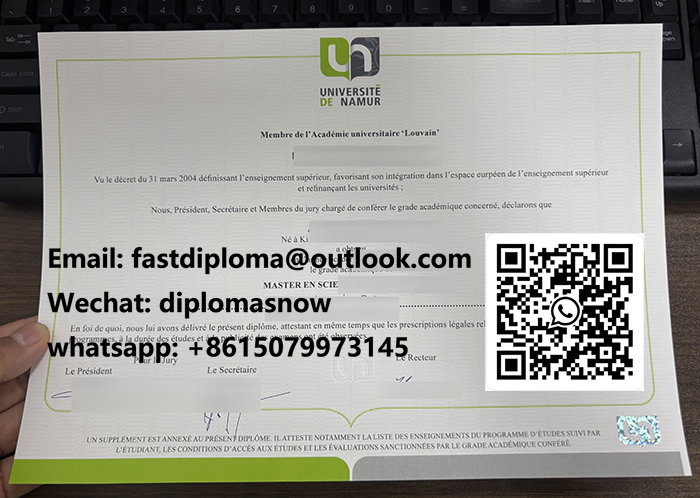
Université de Namur degree
The University of Namur (Université de Namur, abbreviated UNamur) is a public Catholic university located in Namur, Order a Université de Namur degree. Make a Université de Namur diploma. the capital of the Walloon region of Belgium, at the confluence of the Meuse and Sambre rivers. Its history dates back to the College of Our Lady of Namur founded in 1831, but its higher education tradition can be traced back to the 17th-century Jesuit institutions of philosophy and theology established in the region. In 1965, the university officially gained university status and was renamed the University of Namur, becoming an important member of the French-speaking Belgian higher education system.
UNamur is a typical medium-sized comprehensive university with approximately 6,500 students, of whom about 15% are international students from over 80 countries and regions worldwide. The university is characterized by its “small but excellent” approach, with a student-to-faculty ratio of approximately 12:1, ensuring that each student receives ample academic attention and personalized guidance. In the 2025 Times Higher Education (THE) World University Rankings, UNamur ranked among the top 800 globally, scoring highly in both “Internationalization” and “Student-Faculty Interaction.” While its overall ranking may not match that of larger institutions like KU Leuven or the Free University of Brussels, it enjoys a strong reputation in fields such as computer science, law, biomedical science, and philosophy, and is widely recognized as a distinctive and powerful university in the French-speaking region of Belgium and even in European academia.
II. Academic Strength: Five Faculties, Highlighting Disciplinary Advantages
UNamur comprises five faculties and several interdisciplinary research centers, offering over 50 undergraduate, master’s, and doctoral programs:
1. Faculty of Philosophy and Letters
Covering fields such as philosophy, history, archaeology, linguistics, and journalism and communication.
The Department of Philosophy boasts the most authoritative research team in moral philosophy and medieval philosophy in the French-speaking region of Belgium.
History and Archaeology, drawing upon the rich medieval cultural heritage of the Namur region, offer a unique master’s program in “Heritage Conservation and Restoration.”
2. Faculty of Law
Offers Bachelor’s, Master’s, and Doctoral programs in law. The Master’s program is further divided into specializations in commercial law, public law, social law, and European law.
Legal research ranks among the top three in the French-speaking region of Belgium, with particularly notable achievements in European human rights law and environmental law.
The Faculty of Law’s student moot court team has won numerous awards in international competitions.
3. Faculty of Economics, Social and Management (Faculty of Sciences Économiques, Sociales et de 4. Faculty of Sciences
Covering fields such as economics, management, sociology, human resources, and public administration
Holds dual AACSB and EQUIS accreditations (in progress, expected to be completed in 2027)
The Master of Science in Management program collaborates with over 50 local companies, offering 6-12 month paid internships.
4. Faculty of Sciences
Core disciplines: Mathematics, Physics, Chemistry, Biology, Geography, Environmental Science
The biomedical research team collaborates deeply with CHU UCL Namur, achieving groundbreaking results in cancer biology and neuroscience.
The Department of Computer Science is one of UNamur’s flagship departments, particularly renowned in Europe for its expertise in cybersecurity and cryptography, and houses a branch of the Belgian National Cyber Security Research Centre (CRCN).
5. Faculty of Medicine
In collaboration with UCLouvain, offering comprehensive medical, dental, and biomedical science courses.
Clinical teaching is primarily conducted at CHU UCL Namur. The Namur Medical School (the largest medical institution in the Namur region) offers a dual-track MD-PhD program for students aspiring to academic and clinical research.
III. Degree Awarding System UNamur awards the following degrees in accordance with the Bologna Process (a framework for European higher education integration):
Bachelor’s Degrees (3 years):
Bachelor of Philosophy
Bachelor of Law
Bachelor of Economics
Bachelor of Management
Bachelor of Mathematics, Bachelor of Physics, Bachelor of Chemistry, Bachelor of Biology
Bachelor of Computer Science
Bachelor of History, Bachelor of Archaeology, Bachelor of Linguistics, etc.
Master’s Degrees (1-2 years):
Master of Laws (Master en Droit), specializing in: Commercial Law, Public Law, European Law, Human Rights Law
Master of Management Science (Master en Sciences de (Gestion), AACSB Accreditation Pathway
Master of Economics (Economiques)
Master of Computer Science (Informatiques), with specializations in Cybersecurity and Data Science
Master of Biology (Biologie), offering specializations in Ecology, Molecular Biology, and Biomedical Research
Master of Philosophy (Philosophie), research-oriented, preparing students for doctoral studies
Master of History and Heritage (Historie et Patrimoine), a featured program
Master of Journalism and Communication (Journalisme et Communication)
Doctorate (Doctorat, 3-4 years)
UNamur awards Doctor of Philosophy (PhD) degrees, covering all faculties and disciplines. Doctoral programs emphasize interdisciplinary research, with interdisciplinary platforms such as the Namur Institute for Complex Systems. Doctoral students must complete advanced research methodology courses and meet academic publication requirements during their studies. Their dissertation defense must be approved by a review committee composed of internal and external experts.
The Higher Education Teacher Qualification Certificate (Agrégation de l’Enseignement Secondaire Supérieur) provides advanced secondary school teacher certification, allowing graduates to teach in the secondary education systems of Belgium and other French-speaking countries.
IV. Tuition Fees and Value for Money
UNamur’s tuition fees are at a mid-to-low level compared to other universities in the French-speaking region of Europe:
Student Category | Bachelor’s/Master’s Annual Tuition Fee (Euros) | Doctoral Annual Tuition Fee (Euros)
Belgian/EU Students | Approx. 835-1,200 | Approx. 550-950
Non-EU International Students | Approx. 2,500-4,500 (depending on the major) Tuition fees are approximately €1,200-€2,500 for popular majors such as law and management science (approximately €4,000-€4,500/year).
Humanities majors such as philosophy and history have lower tuition fees (approximately €2,500-€3,000/year).
Living expenses (including accommodation, food, transportation, and insurance) are approximately €9,000-€12,000/year.
Compared to US public universities (average total annual cost of approximately US$30,000-40,000) and UK universities (average total annual cost of approximately £30,000-£40,000), UNamur’s average annual total cost is approximately €12,000-€16,500, offering excellent value for money and making it a representative institution for low-cost study abroad destinations in Europe.
V. Campus Life and Internationalization
UNamur’s main campus is located adjacent to Namur’s city center, a 10-minute walk from the train station and commercial area. Campus facilities include:
UNamur Library: Houses over 500,000 books, including a valuable collection of medieval manuscripts.
Sports Center: Offers over 30 sports activities, including swimming, rock climbing, fencing, and equestrianism.
Student Accommodation: The university operates over 1,200 dormitory beds, with monthly rent ranging from €250 to €450 (10-15% below market price).
Student Dining: Student meals cost approximately €4.50 to €6.50 per meal.
In terms of internationalization, UNamur is an active member of the Erasmus+ program and has exchange agreements with over 150 universities worldwide. The campus houses a French Language Center (CEL), offering intensive French courses from A1 to C2 levels for international students from non-French-speaking countries. A free 3-week summer French preparatory camp is offered before the autumn semester begins. The International Student Office (Bureau des Relations Internationales) provides one-stop services for visas, accommodation, insurance, and residence permits.